
6 min read
Clippy won every test Microsoft ran
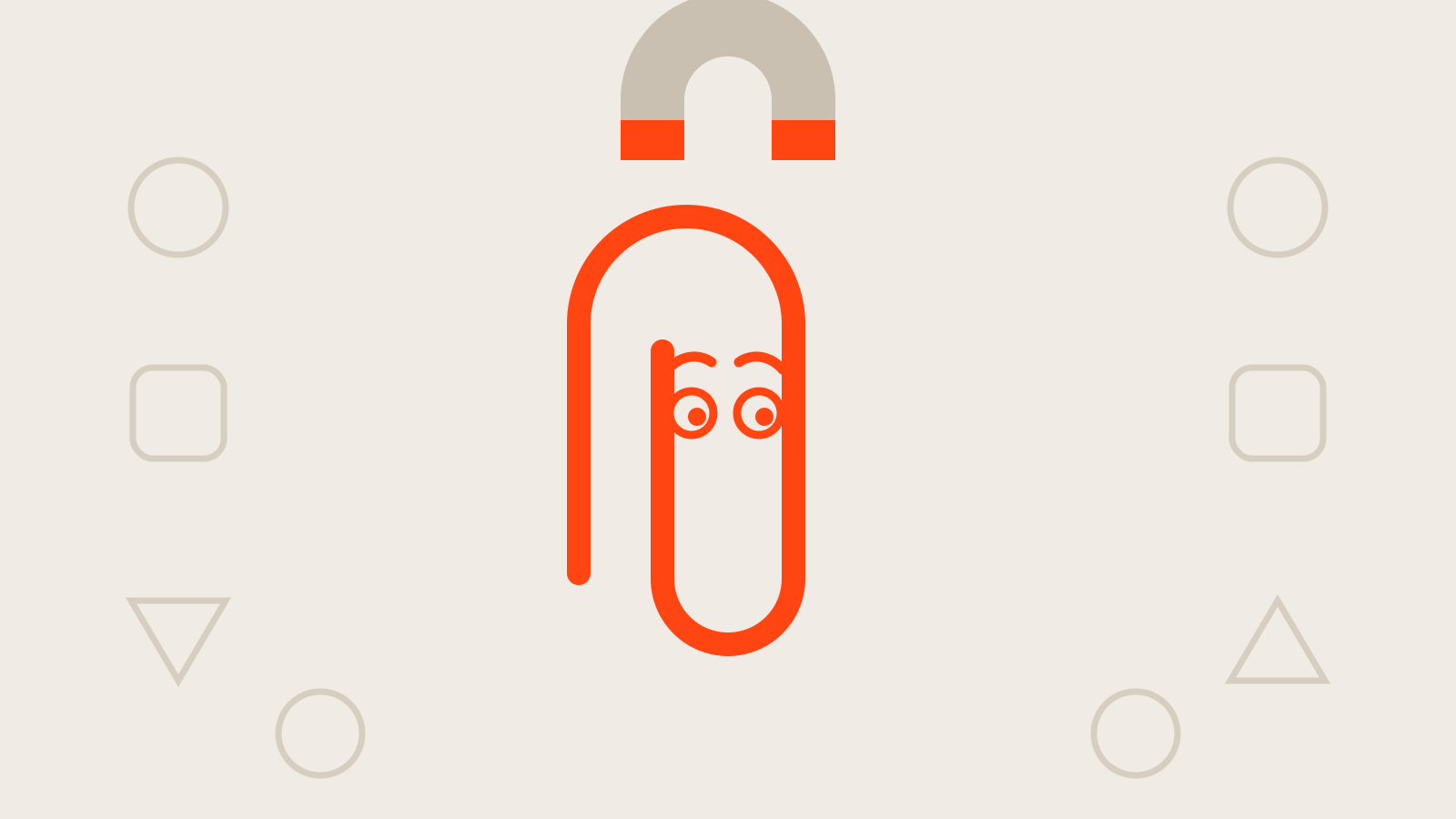
On 31 May 2001, at the Office XP launch in New York, a person in a Clippy costume interrupted the presentation to beg for his job back. Gilbert Gottfried supplied the voice. The bit ended with the character being dragged offstage by a comically oversized magnet, and the audience loved it, and the whole thing was Microsoft’s own marketing department staging the public execution of a character Microsoft had paid to design.
Find another company that has done that to its own mascot. Brands retire characters quietly, in a rebrand, hoping nobody files a petition. Microsoft made the killing into the campaign.
He was the best-tested face in the building
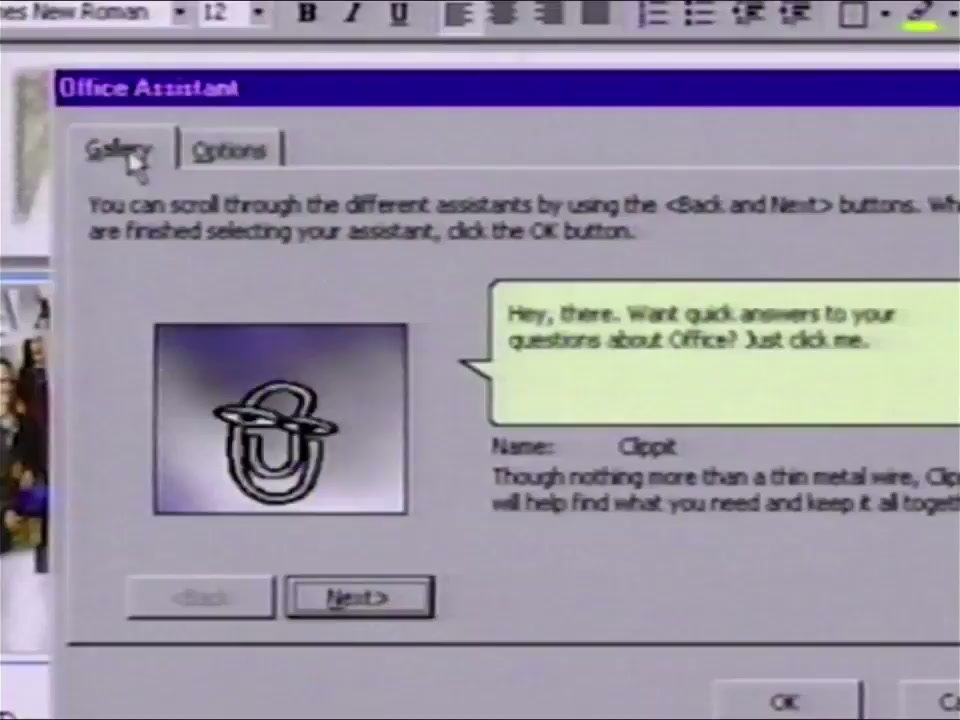
The paperclip came out of the wreckage of Microsoft Bob, the 1995 attempt at a friendly house-shaped interface for people frightened of computers. Bob failed fast. Microsoft moved the contract of one of its illustrators, Kevan Atteberry, onto the next character-driven project instead: the Office Assistant.
Atteberry has described drawing the paperclip with a Ticonderoga pencil at his own studio in Bellevue, then digitising it on the Macintosh he preferred to his employer’s PCs. His paperclip went into a pool of roughly 250 candidate faces. Atteberry had drawn a handful of them himself, a rabbit and some other office objects among them. The whole pool went through focus groups, and then through evaluation with Stanford psychologists on how trustworthy and friendly each candidate read to an ordinary user.
Clippit, to use the name on his birth certificate, passed every metric. He was not the cheap option or the safe option or the one a vice president liked. He was the empirical winner of the largest character bake-off any software company had run to that point, and he won on precisely the two qualities the internet would later insist he did not have.
The research underneath him was also correct
This is the part that makes the story worth telling rather than just enjoying.
The intellectual foundation for Bob and for the Office Assistant came substantially from work by Byron Reeves and Clifford Nass at Stanford, published in 1996 as The Media Equation. Across dozens of laboratory experiments they showed that people apply social rules to computers without noticing they are doing it. Politeness, reciprocity, judgements about personality and competence. Their subjects were technically sophisticated adults who would have denied doing any of it. The two of them consulted for Microsoft on Bob.
So the premise Microsoft was working from was not a whim. It had been tested more rigorously than most branding decisions ever are, and it was right. Give the software something that reads as a social presence and people will relate to it socially.
That is exactly what happened. It is also what went wrong.
People treated him like a colleague, so they judged him like one
Once you relate to something socially, you start holding it to social standards, and Clippy could not meet a single one of them.
A study a few years later found the assistant broke basic norms we apply to a co-worker, the most damning being that he interrupted without asking permission first. Focus group participants kept mentioning his eyes, which they read as leering. Both of those are complaints about a person. Nobody has ever accused a wordmark of leering at them. Nobody has ever said their bank’s logo interrupted them.
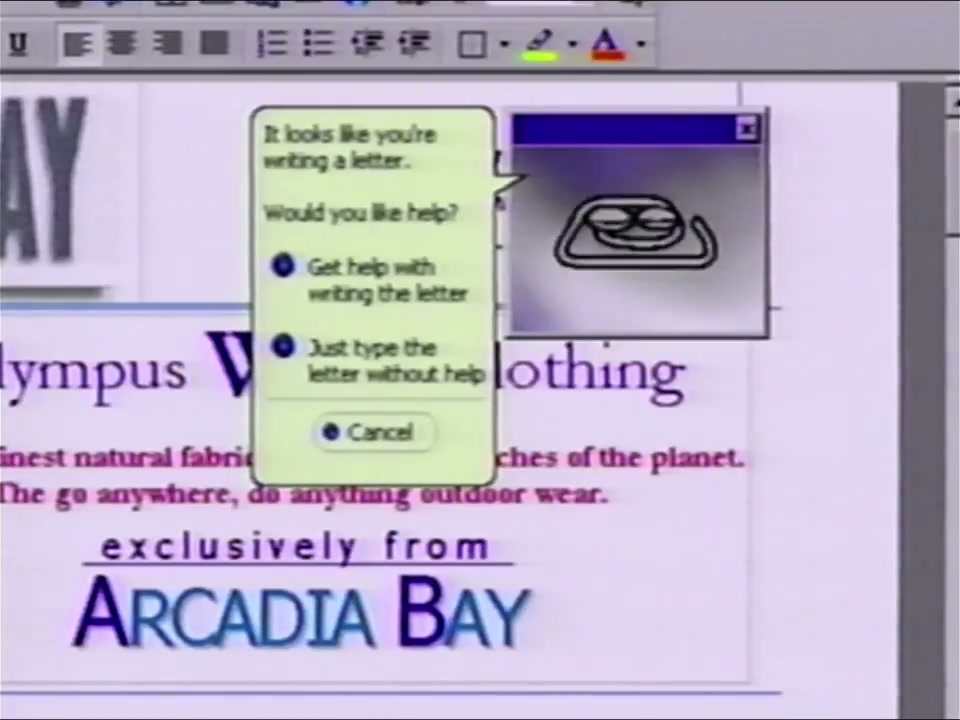
And notice what he was interrupting with. The Office Assistant sat on a model that watched what you typed and guessed at what you were doing, in 1997, with 1997 accuracy. It famously guessed letter. The more competent you got, the more you triggered offers of help you did not need, which meant the character got worse company the better you got at your job.
None of that is a fact about the drawing. Every bit of it is a fact about the feature. The drawing gave people somewhere to put the feeling.
A character absorbs whatever the product does
That is the mechanism, and it is the whole reason a mascot is worth commissioning or worth being careful about.
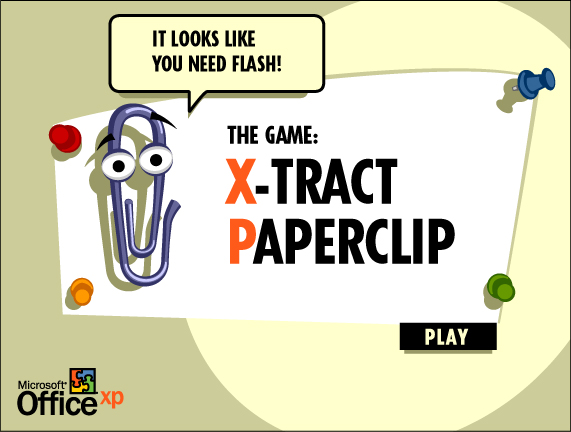
An interruption from a dialog box is an annoyance you forget. The same interruption from something with eyes and eyebrows becomes a relationship with a personality you resent. The character collects everything the product does and gives the user a face to direct the feeling at, which is enormously valuable when the product behaves well and merciless when it does not. Microsoft got the merciless version and understood it well enough to weaponise it, announcing in April 2001 that the Assistant would be off by default, then building launch marketing around the removal. By Office 2007 he was gone from the default experience entirely.
The counter-case is what happened next, and it is the most useful part of the record.
The drawing was fine the whole time
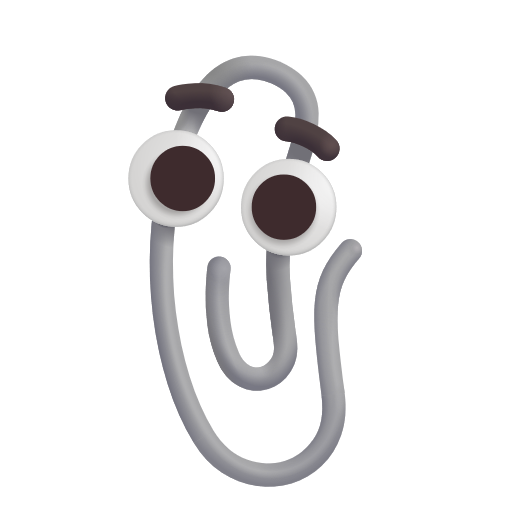
In July 2021 Microsoft posted the paperclip on Twitter and said that at twenty thousand likes, Clippy would replace the paperclip emoji in Microsoft 365. It cleared that in a morning and kept going past a hundred and seventy thousand. He shipped as an emoji later that year, alongside the redesigned set in Teams and Windows.
The character had not been improved. No one softened his eyes or fixed his eyebrows or gave him a warmer palette. He was the same paperclip who had been dragged offstage by a magnet twenty years earlier, and people were pleased to see him. What had changed is that he no longer had a job. He could not interrupt anybody, and once that was true the affection that had always been available to the drawing had nothing sitting on top of it.
There is a further irony that Microsoft is currently living inside. The company has spent the last few years rebuilding the Office Assistant across its entire product line: software that watches what you are doing and offers to help before you ask. That is Clippy’s job description word for word. Nobody is staging an execution this time, because the guesses are better now. Same premise, different hit rate, and the hit rate was always the thing on trial.
If you take one thing from the most famous failure in character design, take this. You are not commissioning a face for your company. You are commissioning a face for your product’s behaviour, and it will be blamed for that behaviour with complete accuracy.
We design characters for software, including the parts of it that interrupt people. Tell us what yours has to carry.