5 min read
When a mascot is a great idea (and when it isn't)
Mascots are having a moment. Duolingo’s owl is on TikTok. Every B2B SaaS company seems to be launching a creature. Investors are noticing that mascot-led brands tend to have unusually loyal users, and the market for character design work is the busiest it has been in a decade.
Which means a lot of brands are about to commission mascots they shouldn’t.
We’re a mascot studio, so this might seem like a strange post to write. The work we’re proudest of is for brands where the mascot was the right answer. The work we’ve watched fail (sometimes ours, mostly other people’s) was almost always work where the mascot was solving the wrong problem. If you’re considering commissioning a character, here’s the honest framework for figuring out whether you should.
Mascots solve four problems. They don’t solve anything else.
A mascot is useful when your brand has one of these specific challenges.
You’re invisible in a sea of sameness
Categories like productivity SaaS, fintech, developer tools, and DTC consumer brands tend to converge on the same visual language: clean sans-serif, two-color palette, geometric illustration, abstract gradient. If your category looks like this, a mascot is one of the few moves that breaks the pattern instantly. The mascot doesn’t have to be remarkable. It just has to exist while your competitors don’t have one.
Your product has emotional stakes you’re not addressing
Healthcare, finance, education, and anything involving children are categories where users have real feelings (anxiety, hope, confusion, pride) that the product is supposed to address but the marketing usually doesn’t. A mascot is permission to engage with those feelings without being patronizing. Duo’s “passive-aggressive about your Spanish streak” works because forgetting your lessons feels bad, and a character can acknowledge that in a way a banner ad cannot.
You need to be present in moments where text fails
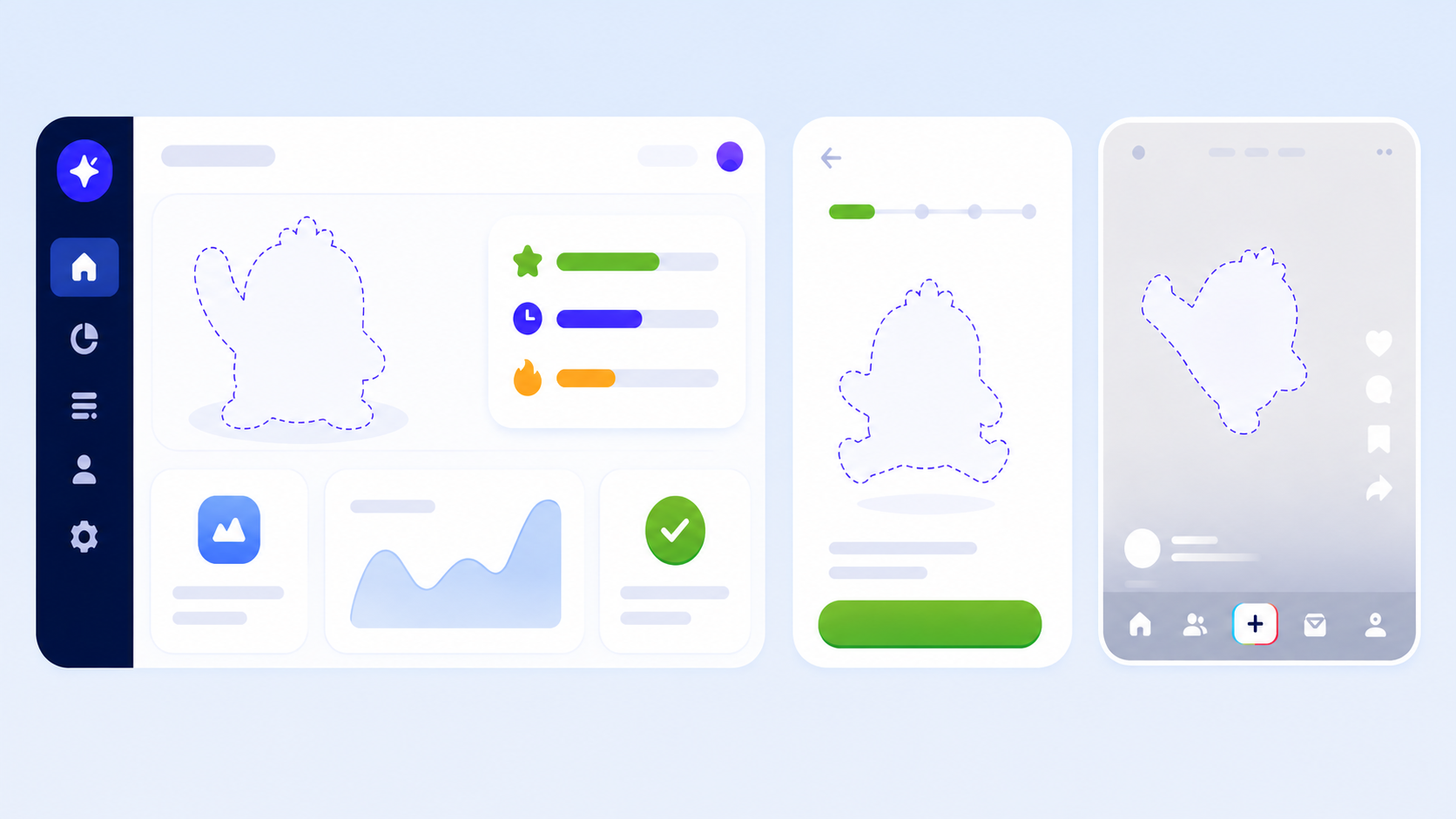
Empty states, error messages, loading screens, and onboarding flows are places where prose feels clinical and silence feels cold. A character occupying those moments is a form of brand presence that doesn’t require copy. This is the Wumpus argument: the mascot’s value is mostly about where it shows up, not what it says.
You’re a platform that wants community participation
If your product is essentially “we host other people’s stuff” (Reddit, GitHub, Discord, Twitch), a remixable mascot is one of the strongest brand moves available. The character becomes a kit that communities use to make their own version, which turns brand identity into user-generated content.
If none of these four describe your situation, you probably don’t need a mascot. You might want one. But you don’t need one, and the difference matters because mascots are expensive to design and much more expensive to maintain.
The cost most people don’t see coming
The design fee is the cheap part of having a mascot. The expensive part is everything that comes after.
A mascot needs an expression library, which means you’re commissioning illustration work continuously, not once. It needs to be present across product, marketing, social, and merch, which means somebody on your team owns mascot governance and pushes back when designers want to use it in ways that hurt the character. It needs to evolve as your brand evolves, but not so much that it stops being recognizable. It needs voice and tone guidelines, because the moment your social team makes the mascot say something off-brand, you have a PR conversation on your hands.
If you don’t have the budget or the appetite for that ongoing investment, the mascot will quietly atrophy. It will show up on the homepage for a year, then disappear from new templates, then become an awkward legacy asset that nobody knows what to do with. We have seen this happen to mascots we did not design, and we have politely declined to design mascots for brands we suspected would let this happen.
The rough rule: if you can afford to commission a mascot but you can’t afford to use one consistently for the next three years, don’t commission one. Spend the budget on a stronger wordmark and a better illustration system.
Three questions that surface the real answer
Before commissioning, sit down with whoever owns brand at your company and answer three questions honestly.
If the CMO leaves in eighteen months, will the next one keep the mascot?
Mascots are personal. They tend to be associated with the person who championed them, and a new brand leader will be tempted to retire the character as a way of making their mark. If the mascot is built into the product (Duo, Wumpus, Octocat), this is harder to do. A marketing-only mascot is easy to kill. Be honest about which one yours would be.
Will the mascot live in the product or only in marketing?
Product-resident mascots survive. They show up in onboarding, error states, success moments, and notifications, which means users encounter them dozens of times per session. Marketing-only mascots are seen briefly on websites and in ads, then disappear. They have shorter lives because they don’t accumulate user attachment.
Do you have a culture that defends polarizing creative work?
Mascots that succeed are usually a little weird. Gritty is unhinged, Duo is passive-aggressive, the trash raccoon is feral. If your brand culture is “we want everyone to like us,” your mascot will get sanded down until it has no personality, and then it won’t accomplish what mascots are supposed to accomplish.
When the answer is no
It’s worth saying directly: there are good brands that should not have a mascot. Luxury categories, professional services where trust is the primary brand attribute, and most B2B enterprise software where the buyer is a procurement officer rather than an end user: these are categories where a mascot tends to undermine credibility rather than build affinity.
There are also brands that already have strong differentiation through other means (a distinctive product, an iconic founder, a memorable name) and don’t need a character to be memorable. Adding a mascot to those brands is at best redundant and at worst confusing.
If you’ve read this far and concluded a mascot isn’t the right move for you, that’s a useful conclusion. It saves a six-figure investment and a couple years of brand fragmentation.
When the answer is yes
If you fit one of the four problem categories above, you can afford ongoing investment, and you have leadership willing to defend a character with personality, then a mascot is probably the strongest brand move available to you in 2026. The category is still underbuilt. Most of your competitors are still using abstract illustrations of people pointing at laptops. There’s room to claim a character before someone else does.
The next step isn’t to start sketching. It’s to write a clear brief about what the mascot needs to do in your specific business: where it lives, what it expresses, what jobs it’s hired to perform across product and marketing. That brief is the difference between a mascot that becomes brand infrastructure and a mascot that becomes a logo nobody updates.
We help brands figure out whether a mascot is the right move, and design the ones that should exist. If you’re trying to think this through, we’d love to talk.